
January 2026 monthly investment news
With a round up of the global markets, Zurich's monthly investment news gives a comprehensive guide to whats been happening across the markets and key fund performances.

2025 was a year defined by turbulence and complexity in global markets. Early on, trade tensions surged as the US hiked tariffs to heights not seen since the 1930s, sparking a dramatic sell-off in equities in April.
Yet despite these headwinds, markets rallied and global equities closed the year up 6.8% in euro terms. December capped off a strong but complex year, as investors weighed the staying power of the AI-fuelled boom, growing debt concerns, and shifting global dynamics.
Amidst short-term fatigue, market leadership broadened, value stocks surpassed growth, and international markets, especially Europe and emerging markets, outperformed. The Fed delivered a widely expected rate cut, but uncertainty lingers about what lies ahead in 2026.
Activity
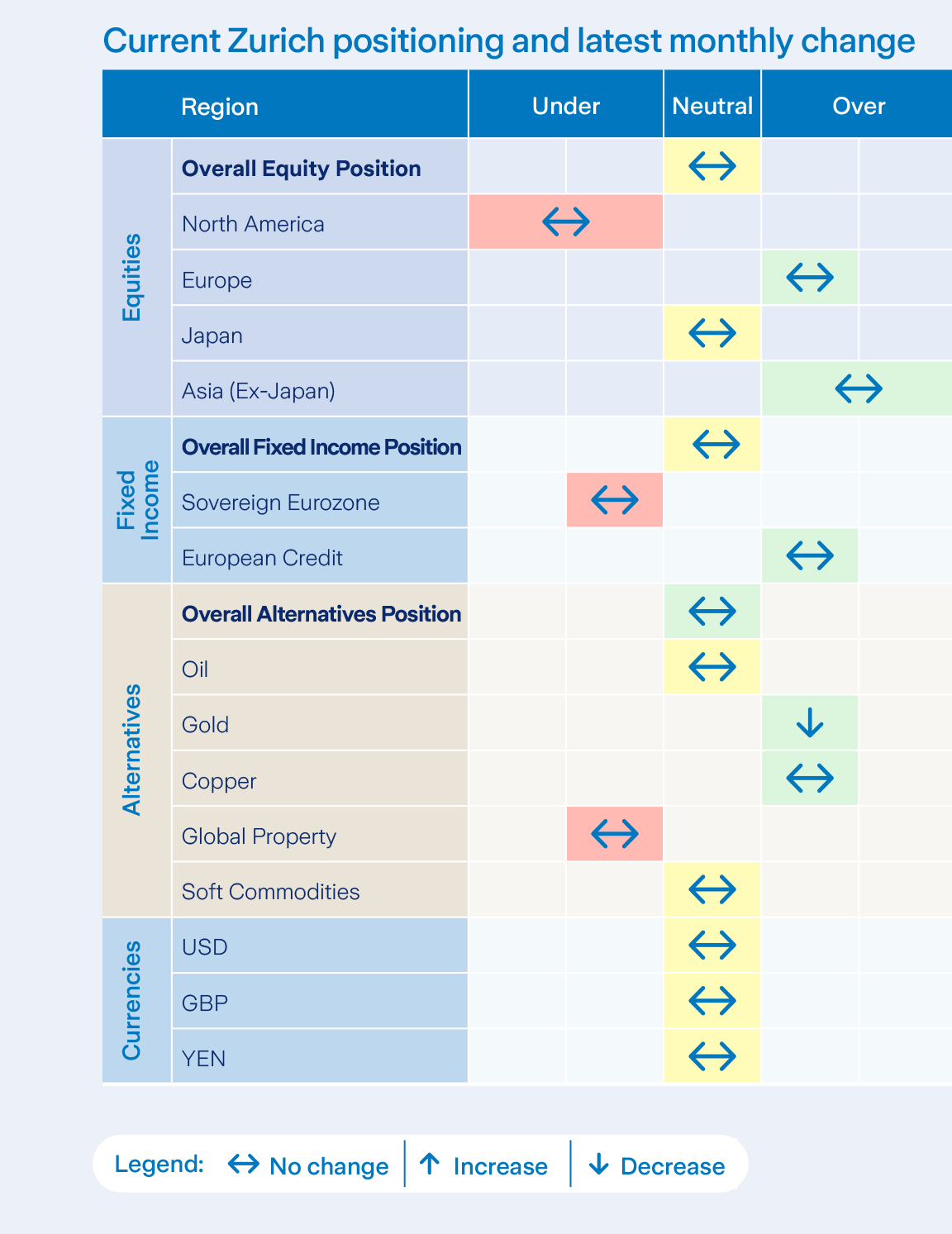
In December, we lowered our allocation to Alternatives within the Active Asset Allocation fund and related Prisma funds by reducing our gold holdings. The proceeds were reinvested into the Short-Term Bond Fund. The main reason for selling gold was to realize profits after its substantial gains this year. Additionally, in December, we trimmed the slight equity overweight in the Managed funds, which had passively increased. Of the reduction, 80% was from US equities and the rest from European equities, with proceeds held in cash.
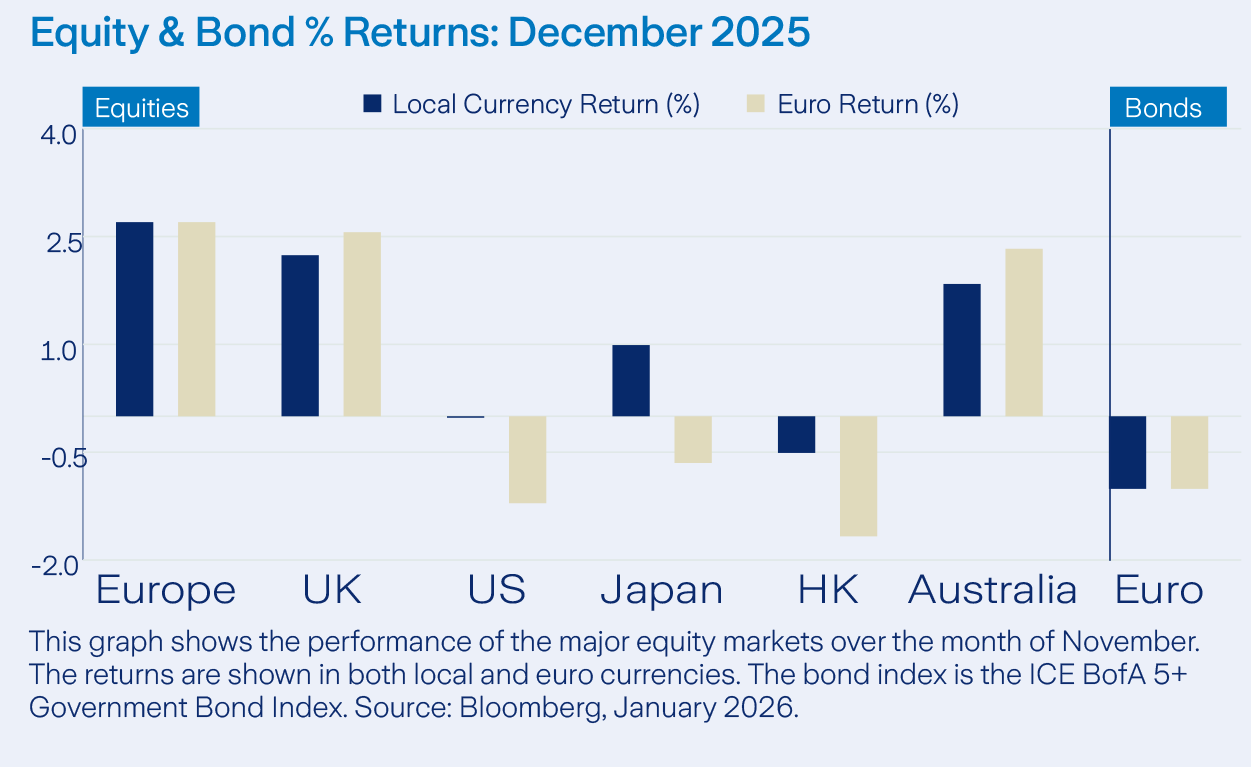 This graph shows the performance of the major equity markets over the month of November. The returns are shown in both local and euro currencies. The bond index is the ICE BofA 5+ Government Bond Index. Source: Bloomberg, January 2026.
Equity markets
US equities had a muted overall performance in December, though underlying market dynamics shifted noticeably. Mega-cap tech lost momentum as investors rotated into cyclical stocks, indicating a move toward more selective interest in AI-related companies. Eurozone equities finished the year strongly, driven by rising optimism about the region’s economic prospects and earnings growth for 2026. Sector results were mixed, eight of eleven declined, while Financials (+3.3%), Materials (+2.7%), and Industrials (+0.8%) gained. Utilities (-4.1%) and Real Estate (-2.9%) were the weakest sectors for the month in euro terms.
Bonds and interest rates
Global government bonds delivered negative returns in December as long-term yields increased across most regions. The US 10-year Treasury yield rose to 4.17% after the Fed’s December rate cut. In Europe, German Bunds lagged, with 10-year yields up 17 basis points. The Federal Reserve lowered its federal funds rate by 25 basis points to a range of 3.5%–3.75%, marking the third cut of 2025 and matching market expectations. The ECB kept rates unchanged for a fourth straight meeting. The Bank of Japan lifted its policy rate by 25 basis points to 0.75%, the highest in 30 years.
Commodities and currencies
Oil prices fell for the fifth consecutive month, with WTI and Brent both ending lower. WTI closed 2025 down 20%, driven by increased expectations of oversupply amid conflicts, higher tariffs, greater OPEC+ production, and ongoing sanctions on Russia, Iran, and Venezuela. Gold gained 1.9% in December, finishing the year up nearly 65% in US Dollar terms, supported by safe-haven demand after notable US actions in Venezuela and tensions over Greenland. The US dollar weakened against the euro, with 1 euro purchasing 1.175 USD by the end of December up from 1.160 at the end of the previous month.
Warning: Past performance is not a reliable guide to future performance.
Warning: Benefits may be affected by changes in currency exchange rates.
Warning: The value of your investment may go down as well as up.
Warning: If you invest in these funds you may lose some or all of the money you invest.



Related articles





Filter by category
Follow us on


