
AI jitters shake markets as investors seek safer ground

Equity markets experienced a relatively turbulent October as stocks related to Artificial Intelligence (AI) faced growing scrutiny over whether the levels of capital being deployed to AI infrastructure would generate a second wave of earnings momentum.
Although the broader market declined only modestly, sharp losses among mega-cap technology stocks and related emerging-market companies weighed on headline returns. Beneath the surface, investors rotated into other sectors as they sought to diversify exposure. Bond markets also benefitted from this drive for diversification, with government bonds generally gaining as yields retreated slightly from the elevated levels reached in September, with a notable exception being French sovereign debt. Meanwhile, in currency markets, the euro remained under pressure owing to a combination of US dollar strength and concerns surrounding France’s fiscal outlook, which contributed to a widening of French sovereign bond spreads relative to Germany.
Market activity
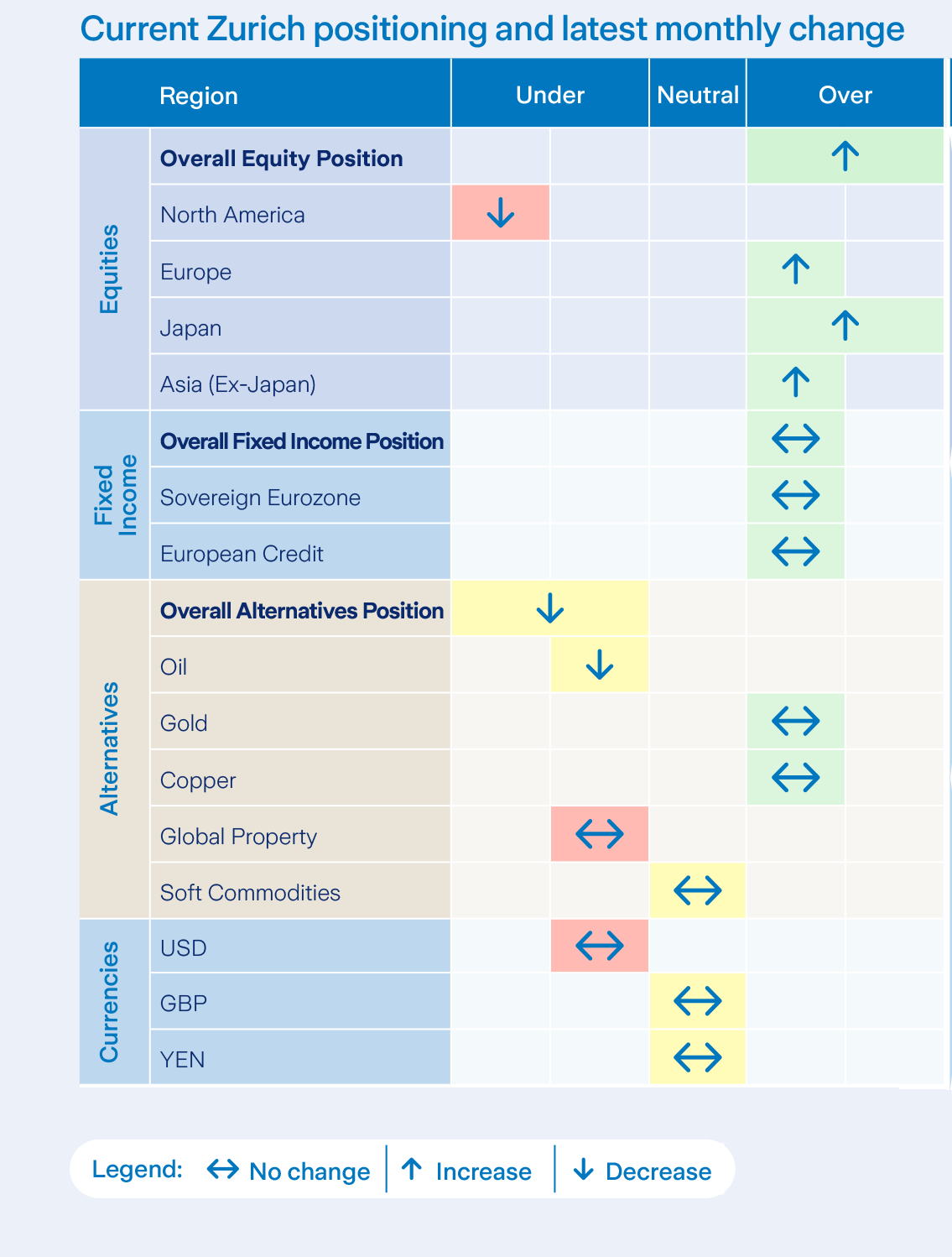
Throughout October, we continued adding to equities in Active Asset Allocation (with standard Prisma cascading) and our managed funds to raise the equity content from 60% to 75% of their relevant equity ranges.
Equity market performance has been remarkably resilient, particularly considering headwinds such as sharply higher bond yields, central banks’ increased focus on tackling inflation, and ongoing political concerns.
There have been tentative signs that some of these risks may be peaking, improving the overall risk-reward profile of increasing our equity allocation. Our recent equity moves have been funded through cash where available, with the balance funded by sales of short-term bonds, property and commodities, including oil.
Equity markets
Despite a weaker backdrop for global equities this month, market leadership shifted meaningfully. Energy (+14.5%) led returns as oil continued to benefit from renewed unrest in the Middle East, while traditionally defensive areas such as consumer staples (+12.4%), healthcare (+11.5%) and utilities (+9.5%) also delivered strong returns. Information technology (-5.6%) and communication services (-12.2%) lagged as investors reassessed whether the substantial investment being directed towards AI will ultimately be reflected in stronger corporate earnings.
European shares delivered positive returns for the sixth month in a row, although fiscal and political developments in France remained an area of investor focus.
Bonds and interest rates
In general, bond markets recovered some ground this month as yields retreated from their September highs, with a notable exception being French bond yields which climbed over concerns surrounding the country’s fiscal position and political uncertainty ahead of next year’s presidential election.
Heightened volatility in equity markets prompted investors to rotate towards more defensive assets, supporting demand for sovereign debt. The move in yields was supported by key interest rate decisions from major central banks in October.
The Fed held rates steady at 3.75-4.00%, with markets pricing in one more hike by the end of this year. The ECB also remained on hold this month at 2.50%.
Commodities and currencies
Oil prices climbed further this month amid continued concerns over the escalation of conflict in the Middle East. Further attacks on ships in the Strait of Hormuz added to this pressure, while investors also considered the prospect of further US action after the November midterm elections. WTI closed the month at $104.12 a barrel, up from $90.42 at the end of September. Precious metals fell, with gold falling roughly 5% in euro terms as investors favoured US Treasuries over other perceived safe-haven assets. The euro continued to weaken, ending the month at $1.116, down from $1.133 at the end of September.
Warning: Past performance is not a reliable guide to future performance.
Warning: Benefits may be affected by changes in currency exchange rates.
Warning: The value of your investment may go down as well as up.
Warning: If you invest in these products you may lose some or all of the money you invest.



Related articles





Filter by category
Follow us on


