
Jack O’Donoghue: Why every story matters
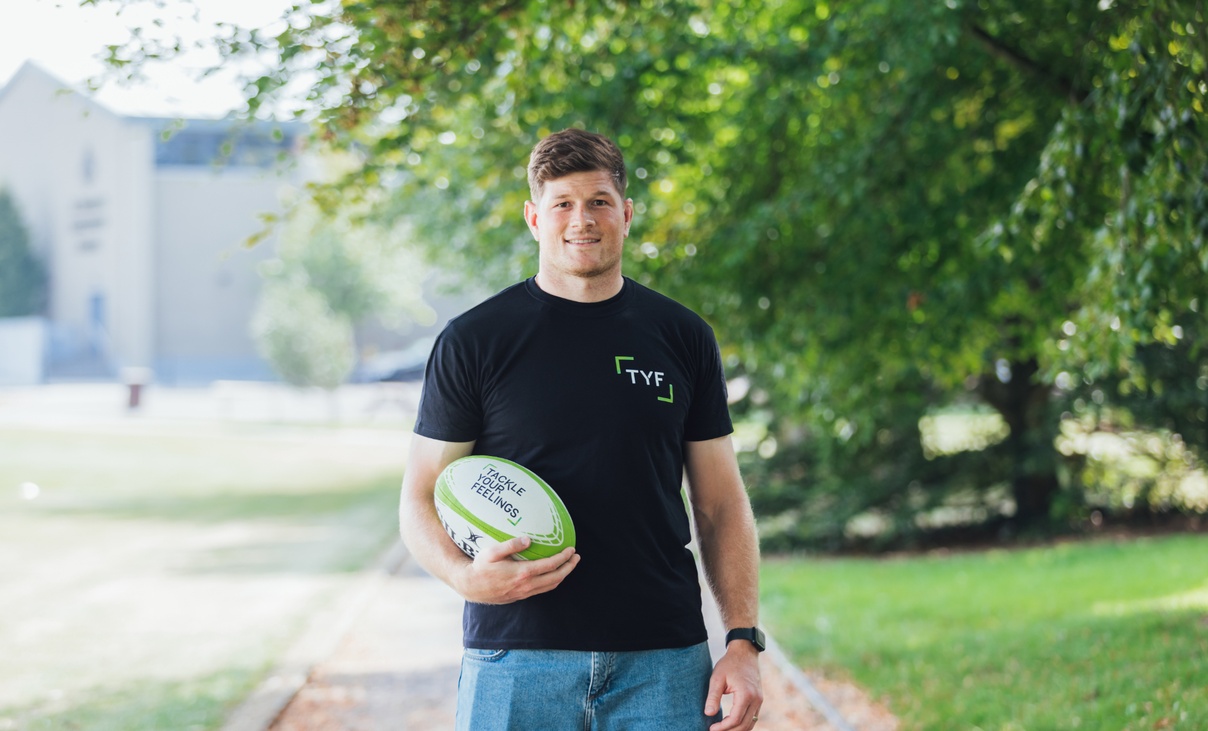
When Jack O’Donoghue first considered getting involved with Tackle Your Feelings, he wasn’t entirely convinced that he belonged in the conversation.
He didn’t have a story of woe, nor one neatly packaged around triumph. While he recognised there was something in his journey through to Munster Rugby, he felt it wasn’t anything out of the ordinary.
“But that’s exactly what we’re looking for,” Marcus Horan assured him. In not so many words, O’Donoghue’s Player Development Manager made the point that there is always something in the ordinary that someone else might recognise.
Prompted by Horan, the Waterford man took time to reflect. Not the fleeting kind that comes on the bus home from a game, but something more deliberate. He began to sit with experiences he had long since moved past. Or chose to keep out of view.
“Maybe five years ago, I wouldn’t have done a piece like that,” O’Donoghue says of revealing his dyslexia in a video for Tackle Your Feelings (TYF). “I wouldn’t have been comfortable enough in myself to put it out into the world.”
It’s a line that lands with a certain weight in the context of the TYF campaign. How many stand in that same quiet reluctance, unsure if their struggles are something to be shared or quietly managed alone?
But time, like a good coach, has a way of teaching you what matters.
“With a bit of encouragement, I’ve realised that I can be a role model for someone out there,” he says.
“I thought back to when I was 13. If I’d heard someone in the Munster team back then talk about how they struggled a bit in school and how they found a way through, it would have made a massive impression on me.
“So I recognised that by doing something simple, by being a bit vulnerable maybe, by opening up a little bit, I might help someone who thinks they’re out on their own.”
As O’Donoghue opened up about dyslexia, there was no fuss in how he said it. It wasn’t choreographed or scripted. It was a straightforward and authentic telling. And that, more than anything, is what tends to carry.
In the days that followed, there was an overwhelming response in the quiet affirmations of the people who crossed his path. A word here, a nod there. And then his network began to kick into gear.
“There was this one kid who was recently diagnosed with dyslexia,” O’Donoghue begins. “He’s mad into sport and stuff like that but wanted nothing to do with school. After seeing the video, his parents reached out to see if I would have a word with him.
“I hopped on the phone and we had a good chat about a rugby, and a bit about school along the way. I just tried to get across to him that dyslexia doesn’t have to be an excuse or something to hide behind. You just have to learn a bit differently, not less.”
He didn’t purport to soften his message.
“There’s little point in running away from things,” he asserts. “I think that applies to everybody. You know yourself, there are days when you just have to face something down, and the more you do it, the easier it gets.
“I had to find ways to live and work with dyslexia but I wouldn’t have found them without having to go through a few tricky situations. School was tough but in the end it taught me as much about myself as anything else.”
It’s not a sugar-coated view, but perhaps that’s why it resonates so well on his classroom visits as part of his TYF ambassadorship. It acknowledges the challenge without letting it define the outcome.
“I don’t envy being a teacher, that’s for sure!” he says of engaging a room of teenage students. “But in fairness, I get something out of it because it pushes me out of my comfort zone.
“Not everyone will speak up and that’s fine. Sure I’d have been in the same boat myself. I’ve been told that a few kids have approached their teacher after the talk looking for a bit more information or a bit of support, and that makes it all worthwhile.”
Of course, the story doesn’t end there. The same challenges follow into environments that can be less forgiving. In a high-performance sport, margins are thin and the expectations aren’t inclined to bend for anyone.
“When I first went into Munster Rugby, you kept the head down,” he says. “You don’t want to stand out for anything other than how you’re playing, and I was happy to toe the line. After a while though, things began to get on top of me and I’d be frustrated on my way home after training.
“I remember when they used to put up a PDF of a set-play on the screen, and I’d look at it with real intent. I’d focus. Stare. And no matter how long I did that for, it just wouldn’t go into my head,” he explained. “I simply couldn’t process what I was looking at and it’d get to me.”
So he found another way.
“Above all, school taught me how to be a visual learner. So after the team meeting, I’d wait until all the lads had cleared off, and then I’d walk through the plays myself in the room. I broke it all down and got myself into the positions, I’d do a phantom lineout lift, walk through pod movements. Literally everything.”
It’s a solitary image, but perhaps not as unusual as it may have felt. As it turned out, several of his teammates had been finding their own way through in much the same fashion. After O’Donoghue’s dyslexia clip was released, that became clearer.
“There were more lads like me in the dressing room than I realised,” he says. “After the video came out, at least three lads in the squad came up to me and told me they were dyslexic too.
“And I suppose if I hadn’t shared my bit, they might not have either.”
If TYF is about anything, it is about starting conversations that might not otherwise happen. And sometimes, those conversations begin in the most familiar of places.
It’s the kind of moment that won’t make headlines, yet it reveals a simple truth that lies at the heart of TYF where openness invites openness.
“I remember the day our coach said, ‘Ok, I know everyone here learns differently, so you’re going to tell me how you learn,’” O’Donoghue recalls. “We started to adapt things and have these ‘Clarity Sessions.’
“We started to use more video, and all the movements were broken down in visual detail. I know it helped me massively.”
What was once labelled a limitation can, in the right environment, reveal itself as simply another way of seeing the world. Rugby Players Ireland is exploring this further through a neurodiversity research project in partnership with Dr Sam Wood in Manchester Metropolitan University. The hope is to provide a clearer picture of the number of professional rugby players in Ireland who may be neurodivergent.
While the findings will add to the wider understanding of the issue, O’Donoghue has already been imparting advice on his younger teammates.
“It’s good to know that people are paying more attention to this kind of stuff,” O’Donoghue says. “Maybe I’ve been more aware of it but when I see some of the academy lads struggling with calls, I’d recognise some of myself straightaway.
“I try to I’d sit down with them and say, ‘Look, this is what I do’, and by the next session, you’d see the difference. A few small tweaks can have a big impact.”
There’s a quiet satisfaction in helping someone avoid the same frustrations you once faced. And in that sense, his role within TYF extends far beyond the classroom or any campaign video. It’s lived daily, in small interactions that accumulate into something meaningful. And maybe that’s the point.
In the end, a simple message may be the most important play he ever makes.



.jpg)






 Sending Response, please wait ...