
Monthly investment news April 2026
March was a challenging month for global markets. We take a look at whats been happening across the investment markets and Zurich's current fund positioning.

The US and Israel launched military action against Iran, which led to retaliatory strikes across the Gulf. The Strait of Hormuz, one of the world’s busiest trade routes, was blocked. This disrupted 25% of the world’s oil, 20% of its natural gas, and 30% of its fertilizer supply. As a result, oil and gas prices shot up, stoking fears of inflation. Central banks had to rethink their policies, pushing bond yields higher. Stock markets faced challenges, with only the energy sector showing gains. Even safe-haven assets like gold weakened as investors sought liquidity in such uncertain times.
Investment market activity
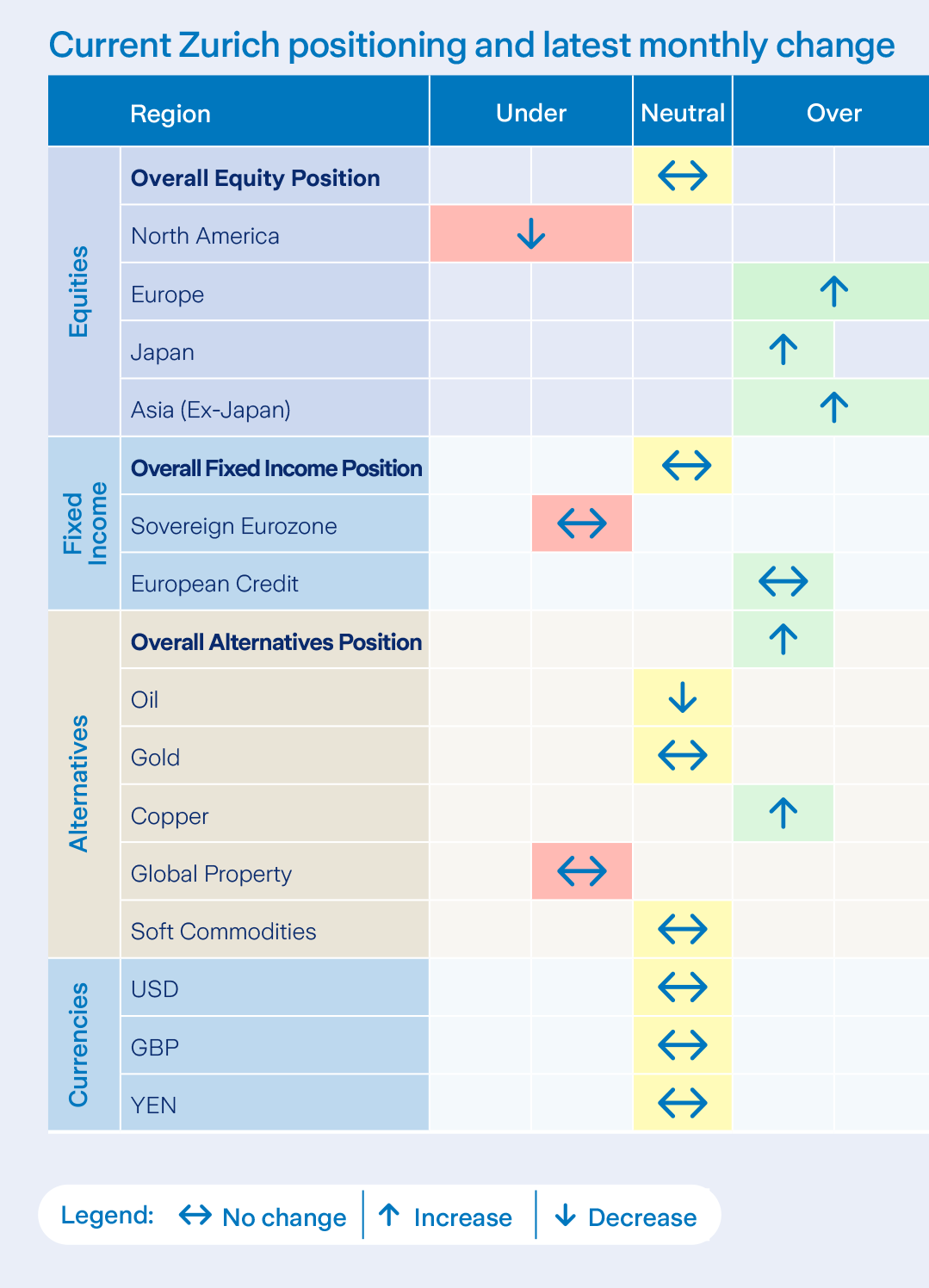
In response to these events, we made changes to our investment mix in March. Here’s what we did:
- We moved some equity exposure from the US to Europe and Japan. Europe and Japan under-performed during the Middle East conflict, but we expect this to reverse depending on US policy and its impact on oil prices.
- We cut back on short-term US Treasury holdings and used that money to invest in euro-denominated bonds. However, we’re still cautious and remain underweight on total bond duration.
- In our multi-asset funds, we’re currently neutral on equities but slightly overweight in euro corporate bonds while staying short on duration. On the equities side, we favour Europe and Japan and are underweight in North America compared to the benchmark.
Equity markets
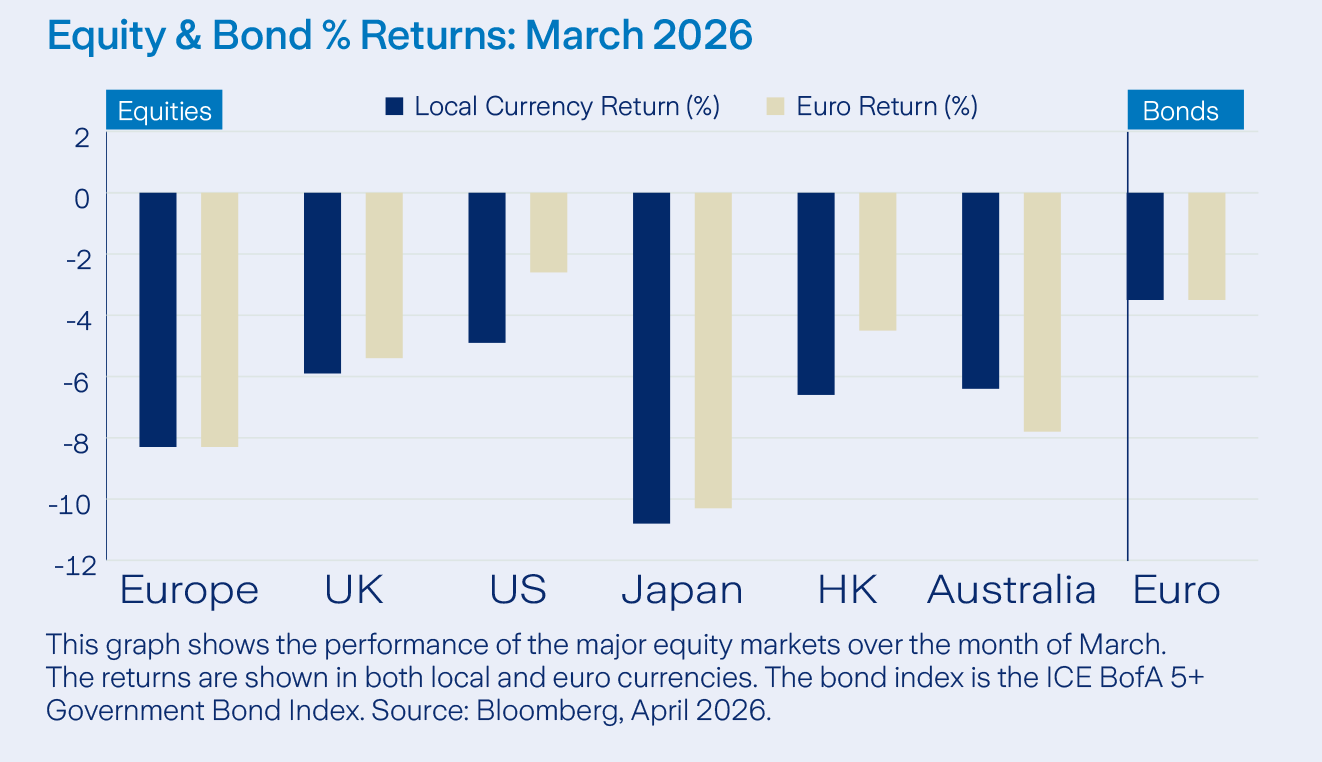
Stock markets were shaken in March. Rising tensions in the Middle East and surging energy prices rattled investors.
- Eurozone and Asian markets were hit hard, while US stocks declined slightly but managed better (-2.6% in euro terms).
- Despite the rocky period, most markets avoided a full-blown correction (a decline of 10% or more), showing surprising resilience.
- The energy sector was the standout performer, gaining 14.1%, thanks to spiking crude oil prices over supply and geopolitical fears. Every other sector ended in the red. The hardest-hit were Industrials (-8.4%) and Materials (-8.2%).
Bonds and interest rates
The bond markets saw a selloff in March. Prices fell, and volatility increased.
- Rising oil prices and concerns over inflation made investors rethink central banks’ next steps. Many now expect tighter policies and higher interest rates for longer, especially in the US.
- Sovereign bond yields rose sharply. For example, UK 10-year yields hit 5.0%, Germany’s 10-year yields reached 3.1%, and US 10-year Treasuries jumped over 40 basis points to 4.4%. This highlights the shifting sentiment and uncertainty globally.
Commodities and currencies
Geopolitical conflict in March sent shockwaves through commodity and currency markets:
- Oil prices soared, with WTI Crude jumping from $67.02 to $102.88 a barrel – a staggering 51.3% gain in USD.
- Inflation concerns strengthened the US dollar, while the euro weakened to 1.155 USD by month’s end. Europe’s reliance on imported energy played a role in this decline.
- Gold, a typical safe-haven asset, surprisingly dropped by -11.6% in USD. Although conflicts usually boost gold prices, a stronger dollar and reduced confidence in immediate Fed easing led to this drop.
Warning: Annual management fees apply. The fund growth shown below is before the full annual management charge is applied on your policy.
Warning: Past performance is not a reliable guide to future performance.
Warning: Benefits may be affected by changes in currency exchange rates.
Warning: The value of your investment may go down as well as up.
Warning: If you invest in these funds you may lose some or all of the money you invest.




.jpg)


.jpg)


 Sending Response, please wait ...